













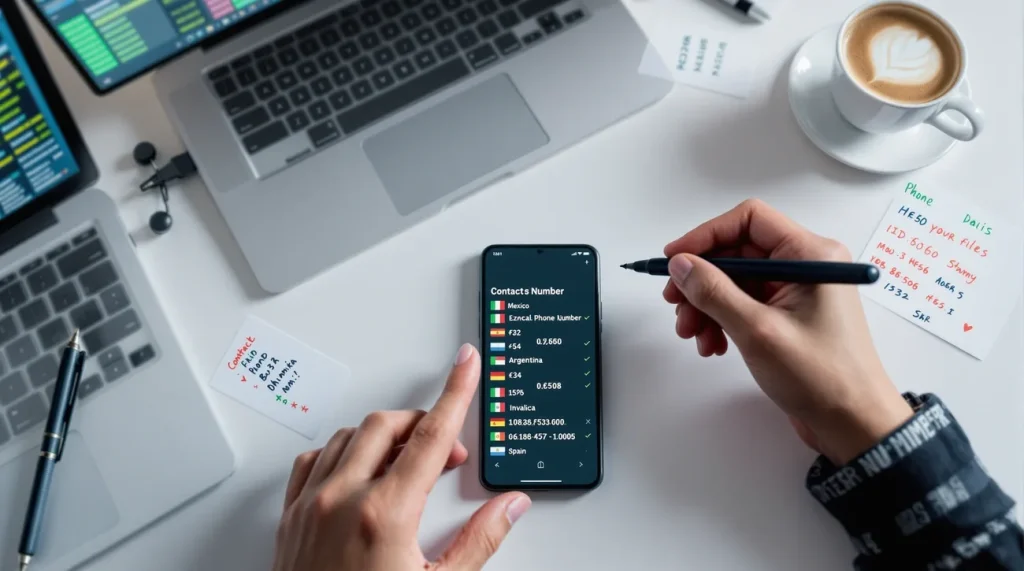
In this article, you’ll learn everything you need to validate phone numbers correctly and avoid costly errors in your communications. Remember that checking numbers before contacting you significantly improves the effectiveness of your campaigns.
What you’ll learn:
• Always use the E.164 format: Include the + sign followed by the country code. This format ensures accurate validations and avoids processing errors that can cost you money.
• Know the difference between syntactic validation and HLR verification: The former only checks the format, the latter confirms whether the number is active on mobile networks. Both are necessary for full verification.
• Take advantage of the free tools available: Services like Verify Email offer you free credits to test validation before investing in premium plans.
• Be aware of number portability: Numbers can change carriers while keeping the same digit, which affects message routing and can incur additional costs.
• Always verify before communicating: Validating numbers in advance reduces SMS costs and missed calls, as well as significantly improving delivery rates.
We recommend that you implement these processes from the beginning. You’ll protect your marketing budget and ensure your messages reach real, active users.
What is phone number validation?
In this article, you’ll learn what it means to validate a phone number and why it’s critical to your communications. Validation confirms that the number you have actually exists, is active, and can receive calls or messages. It is not just a matter of checking that it has the correct format, but also of verifying its real status in telecommunications networks.
Differences between syntactic validation and HLR verification
Did you know that there are different types of verification? Syntactic validation looks only at the structure of the number. Check that it is formatted correctly by country, the number of digits needed, and that it follows the national numbering plan. This check detects obvious errors such as numbers that are too short or with incorrect characters, but it doesn’t tell you if the number is active.
MNP (Mobile Number Portability) verification queries portability databases to identify which carrier currently handles the number. Remember that when a user changes phone company they can keep their number, so this information is valuable to correctly route your messages.
HLR (Home Location Register) verification goes one step further. Directly check the mobile networks to get the real status of the terminal. It provides you with information about whether the number is connected, when it was last connected, identifies the associated SIM card, and detects if the device is roaming. This is the most accurate method for validating phone numbers.
Why should you validate phone numbers?
Validating numbers before contacting your users generates three main benefits:
- Fraud Protection: Detects temporary, disposable, or fake numbers used to create fraudulent accounts
- Economic savings: You avoid spending money on SMS or calls that will never reach their destination
- Effective communication: You ensure that your important notifications reach real users
Cases where you need to verify numbers
Web registration forms are the first scenario where you need to validate numbers. You can check the data entered before completing the registration, asking the user to correct the number if you detect formatting errors or if it is inactive.
Another common case is cleaning up existing databases. If you have contacts stored for a while, some numbers may have changed status. By validating them you can update your communication strategy, using voice calls instead of SMS for numbers that cannot receive messages.
SMS marketing campaigns require pre-validation. This reduces costs by excluding invalid numbers and improves delivery rates by sending only to valid and reachable recipients.
How to Validate Phone Number: Step-by-Step Guide
How can you check if a phone number is valid and active? Below, we will show you the complete process you need to follow to perform an effective verification.
Step 1: Verify the number format
To get started, make sure the number meets the international E.164 standard. This format requires the + sign followed by the country code and subscriber number, without spaces or hyphens, with a maximum of 15 digits in total.
A Spanish number is written +34676112233, eliminating the leading zero from the national format. Remember that numbers can contain between 4 and 15 digits in total, depending on the country of origin.
Step 2: Check the country code
The international prefix identifies the country of origin of the number. Spain uses +34, Mexico +52, and Argentina +54. The United States and Canada share the +1 due to the North American Numbering Plan.
Keep in mind that some Caribbean countries like the Dominican Republic use +1 followed by specific area codes like 809, 829, or 849. Always check that the code corresponds to the correct country before proceeding with validation.
Step 3: Validate with online tools
To validate phone number online, you can use specialized services that check the number structure in real time. Validate your phone numbers with VerifyEmail, which allows you to verify numbers individually or through bulk file uploads.
These platforms process validation in 1-2 seconds and provide you with detailed information about the type of line, operator, and geographic location.
Step 4: Verify Operator and Active Status
HLR verification directly queries mobile networks to confirm if the number is active. This method identifies the current carrier, detects recent portability, and confirms the terminal connection within the last 24 hours.
If you need to validate phone numbers in Mexico, there are specialized services that identify the type of line (mobile or landline), the CPP (Calling Party Pays) modality, the telephone provider and the associated geographical location.
Step 5: Analyze the validation results
Once the verification is complete, the results return information such as the number in international format, the ISO country code, the name of the operator, the type of line (mobile, landline or VoIP), and warning signs about disposable or high-risk numbers. With this information, you can decide if the number is valid for your communications.
Need free tools to check numbers?
You can check phone numbers without investing any money initially. We’ll show you the best options available to clean your database before deciding which service to hire.
Online validators without registration
Want to verify some numbers quickly? Validate your phone numbers with VerifyEmail, which provides you with free credits to evaluate the accuracy of the service before purchasing complete packages.
Other specialized services allow individual consultations by verifying if the number is correctly formatted, active and accessible. These tools identify the type of line and associated operator.
APIs with free trial credits
If you need to integrate validation into your applications, several programming interfaces offer free monthly validations. Some services provide 100 requests at no cost, while others grant up to 1,000 monthly requests in their free tier.
Trial accounts include 100 free credits with no credit card required. It’s as simple as that.
Web Form Plugins
Content management systems incorporate plugins to verify numbers during registration. If you use WordPress, you have extensions that automatically validate the phone details entered in contact forms.
Google’s libphonenumber library, used by Android and WhatsApp, allows you to check the structure of the number, identify the country and detect whether it is mobile or landline. This solution easily integrates into a variety of JavaScript frameworks. If, apart from verifying the structure of the number, you want to check the connectivity status, we recommend that you use the Verify Emails Widget, the integration is immediate and you will be able to validate the phone numbers within your own forms.
Mexico-specific options
Do you work with Mexican numbers? The Federal Institute of Telecommunications offers the Mi IFT application with specific tools for Mexican users, including mobile coverage maps and service comparators.
To validate phone numbers in Mexico, there are services that analyze the type of line, CPP modality, telephone provider and geographical location.
Solutions for Latin America
VerifyEmails is the only provider that allows you to verify numbers in Latin America. To this end, it has developed the HLR+ service, you will be able to know the connectivity status of mobile numbers in this region, thus bypassing the limitation of the HLR service.
Common Mistakes When Validating Numbers and How to Avoid Them
Have you experienced failures in your phone number validations? During the implementation of verification systems, recurring problems appear that can ruin the accuracy of your results. We show you the most common mistakes so you can avoid them before they compromise your communications.
Do not include the international prefix
One of the most frequent mistakes is forgetting the E.164 format, which requires the + sign followed by the country code. Many systems store numbers without this prefix, causing failures when trying to validate the phone number. A Spanish number saved as 676112233 cannot be processed correctly without the initial +34.
Remember that keeping the starting zero of some national formats also generates inconsistencies. We recommend that you always normalize your numbers before sending them for validation, eliminating spaces, dashes, and leading zeros.
Confusing syntactic validation with actual verification
This technical error is very common among users who start validating numbers. Syntax check only checks the structure of the number, detects formatting errors, but does not confirm whether the number is active or belongs to a real user.
To validate phones in Latin America effectively, you need services that query carrier networks using HLR or MNP, obtaining information about the current status of the terminal and its availability. Don’t assume that a properly formatted number is necessarily active.
Ignoring Numbers Ported Between Operators
Number portability allows you to keep your number when you change carriers. During this process, inconsistencies are generated in the HLR databases, causing incorrect results.
If you ignore this variable when validating phone numbers in Mexico or any country with active portability, your messages can be routed to the wrong carrier, increasing costs unnecessarily. We recommend using services that query up-to-date MNP databases to identify the actual operator of each number.
Conclusion
Phone verification is certainly an investment that protects your communications and optimizes your budget. Now you know the steps required to check numbers correctly, from international format to HLR query on mobile networks.
Verify your phone numbers with Verify Email and take advantage of its free credits to clean up your database. Avoid the aforementioned mistakes, always normalize your contacts and check the real status of each line before sending messages.
Your delivery rate will improve significantly when you remove inactive and incorrectly ported numbers.
FAQs
Q1. Are there free tools to validate phone numbers? Yes, there are multiple free tools that allow you to verify phone numbers with high accuracy. Some platforms offer trial credits with no registration required, while others provide between 100 and 1,000 free monthly validations. These tools check the format, identify the operator, and confirm if the number is active.
Q2. What is the difference between syntactic validation and HLR verification? Syntactic validation only analyzes the structure and format of the number according to the country’s numbering plan, but does not confirm whether it is active. HLR verification directly queries mobile networks to determine the actual status of the number, identify the current carrier, detect portability, and confirm if the endpoint is connected to the network.
Q3. How can I check if a phone number is legitimate? To verify the legitimacy of a number, first make sure that it complies with the international E.164 format (with the + sign and country code). It then uses online validation tools that query carrier networks to confirm if the number is active, identify the type of line, and detect whether it is a temporary or disposable number.
Q4. Why is it important to include the international prefix when validating numbers? The E.164 format requires the + sign followed by the country code to successfully process validation. Without this prefix, systems cannot identify the country of origin or apply the corresponding numbering rules, leading to verification errors and can cause message routing failures.
Q5. What information does phone number validation provide? Full validation provides the number in international format, ISO country code, current carrier name, line type (mobile, landline, or VoIP), information on carrier portability, terminal connection status, and alerts on fraudulent or high-risk disposable numbers.