

Comparison prepared by the VerificarEmails team. Because we are comparing our own service with a competitor, we explain how we ran the test and link each data point to its source so you can check it. Reviewed on 11 November 2026.
Short answer
To verify Spanish numbers before a campaign, VerificarEmails gives you the current operator after porting (MNP), the line status (HLR) and file uploads with no coding. Its per-country price list publishes which Spanish networks return the status: 24 of 32. In our test, MNP returned DIGI mobil as the current operator of a mobile ported from Vodafone. You pay in euros, with no subscription and with packs valid for one year, and the servers are in the EU. With the same account you also verify emails, names and addresses, from the API, from its pop-ups with verification or from a remote MCP with nothing to install.
Twilio is something else: a communications platform built for developers. Lookup is just one of its products, alongside SMS, voice, WhatsApp, Verify and Authy. It is used mainly via API, with a key and secret, and each data point (line type, line status…) is a package you have to request with its own parameter. Nor does it offer self-service file uploads. If what you want is to validate a list of phone numbers, with VerificarEmails you don’t have to write any code.
We are talking about Twilio Lookup, the Twilio API that returns data about a number, not Twilio Verify. Before choosing it, check four points in its own documentation. Line Status, its line status lookup, is in public beta, with no SLA, and Spain does not appear in the coverage it publishes. Twilio only documents portability in Canada. There are no self-service bulk lookups: the API looks up one number per request, and the batch API is in private beta, through sales. And its terms for Line Type Intelligence and SIM Swap prohibit using them “for marketing purposes”, without clarifying whether that includes cleaning a marketing list.
| Twilio Lookup | VerificarEmails | |
|---|---|---|
| Company | Twilio Inc. (US) | Spanish company (Barcelona) |
| Support | Its support plans don’t cover beta products, such as Line Status | By phone, chat and email |
| Payment | In dollars, with a prepaid balance; invoicing only with a committed spend of $12,000 a year | In euros, with packs valid for one year and no subscription |
| Where data is processed | US by default, or Ireland if you choose; warns that data may leave the region | Servers in the EU and a published data processing agreement |
| Current operator after porting | Portability documented only in Canada | MNP: current operator and portability flag; in the test, DIGI mobil for the ported mobile |
| Line status in Spain | Line Status, in public beta and with no SLA; Spain does not appear in its published coverage | HLR on 24 of 32 networks, according to its per-country price list |
| Bulk lookups | Not self-service: one number per request; batches in private beta | CSV, XLS, XLSX or TXT files in the dashboard, via API and via MCP |
| Other data with the same account | Lookup only handles phone numbers | Email, name and postal address, plus pop-ups with verification |
| MCP for AI assistants | Documentation server that does not run lookups, plus a proof of concept on GitHub | Remote server with OAuth, nothing to install, that runs HLR, MNP and files |
What this article compares
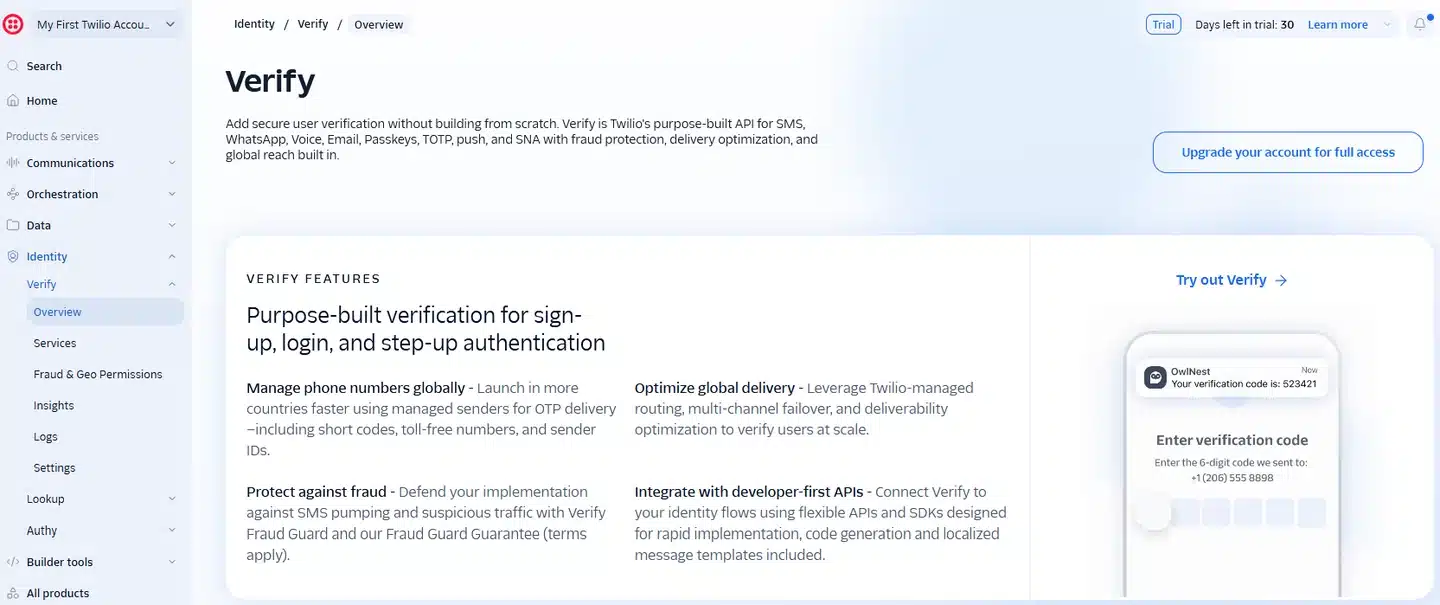
Twilio has two products that are often confused. Twilio Verify sends and checks one-time passcodes (OTP) to authenticate a user. Twilio Lookup sends nothing: it looks up data about a phone number. This article covers Lookup only. If you were looking for Verify to stop SIM swap fraud, we explain it in our article on SIM swap.
We compare the phone lookups of both services with the same scope: format and numbering plan, line type and operator, and line status on the mobile network. For each one we review what it checks, what it returns, what is charged and how much 1,000, 10,000, 50,000 and 100,000 lookups cost. We also review the API, bulk lookups and the MCP.
We leave out the Lookup packages with no equivalent at VerificarEmails: Caller Name and Reassigned Number (US numbers only), Call Forwarding (UK only), Identity Match (identity check) and SMS Pumping Risk (SMS fraud risk). SIM Swap has no equivalent either, but it works with Spanish numbers, so we explain it below.
- VerificarEmails suits marketing or CRM teams that clean lists of Spanish numbers before an SMS campaign, without coding: they upload a file, look up the current operator and the line status, and pay in euros with no subscription. It also suits those who want EU servers or to verify emails, names and addresses with the same account.
- Twilio Lookup suits development teams that already use Twilio and look up numbers one by one from their application, for example when a user signs up.
Hands-on test: four Spanish numbers
We verified four numbers in VerificarEmails with its HLR lookup (line status) and its portability lookup (MNP):
- a mobile with a Vodafone number ported to Digi;
- a Movistar mobile;
- a number from an unassigned range, in other words one that does not exist;
- a Barcelona landline.
We used the VerificarEmails MCP server, first number by number and then with a file. We have not yet been able to test Twilio Lookup with an account. Everything we say about Twilio comes from its documentation.
| Number | VerificarEmails, HLR | VerificarEmails, MNP | Twilio Lookup |
|---|---|---|---|
| Mobile ported from Vodafone to Digi | no-coverage; only returns the original network, Vodafone | mobile; current operator: DIGI mobil (214-22) | Pending test with an account |
| Movistar mobile | connected; original and current network: Movistar | mobile; current operator: Movistar | Pending test with an account |
| Number from an unassigned range | inconclusive, rejected; type unknown | unknown, rejected | Pending test with an account |
| Barcelona landline | inconclusive, rejected; type landline | landline, rejected | Pending test with an account |
| Credits used | 1.10 per number, including rejected and no-coverage ones | 1 per number, including rejected ones | Pending test with an account |
format.e164).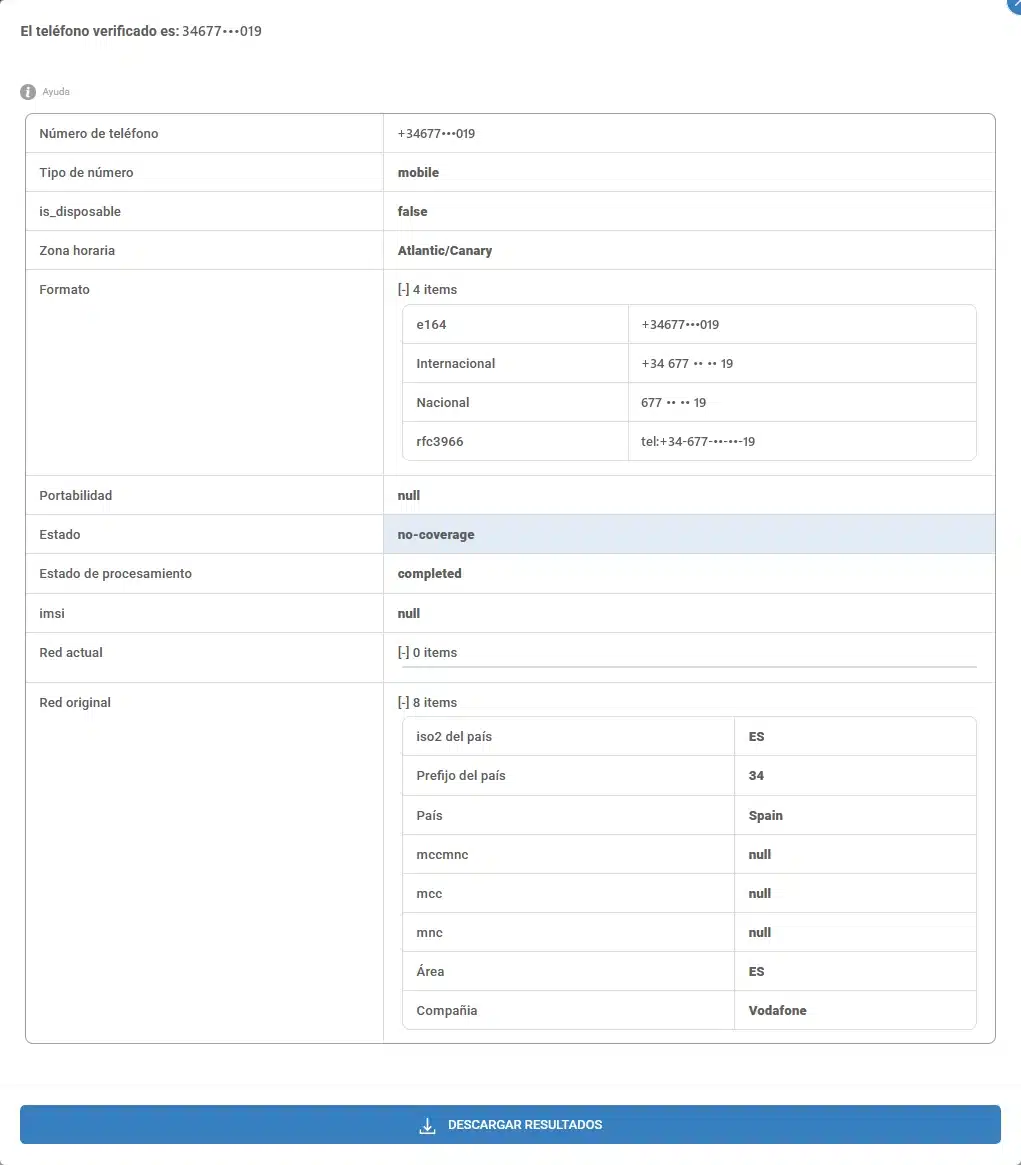
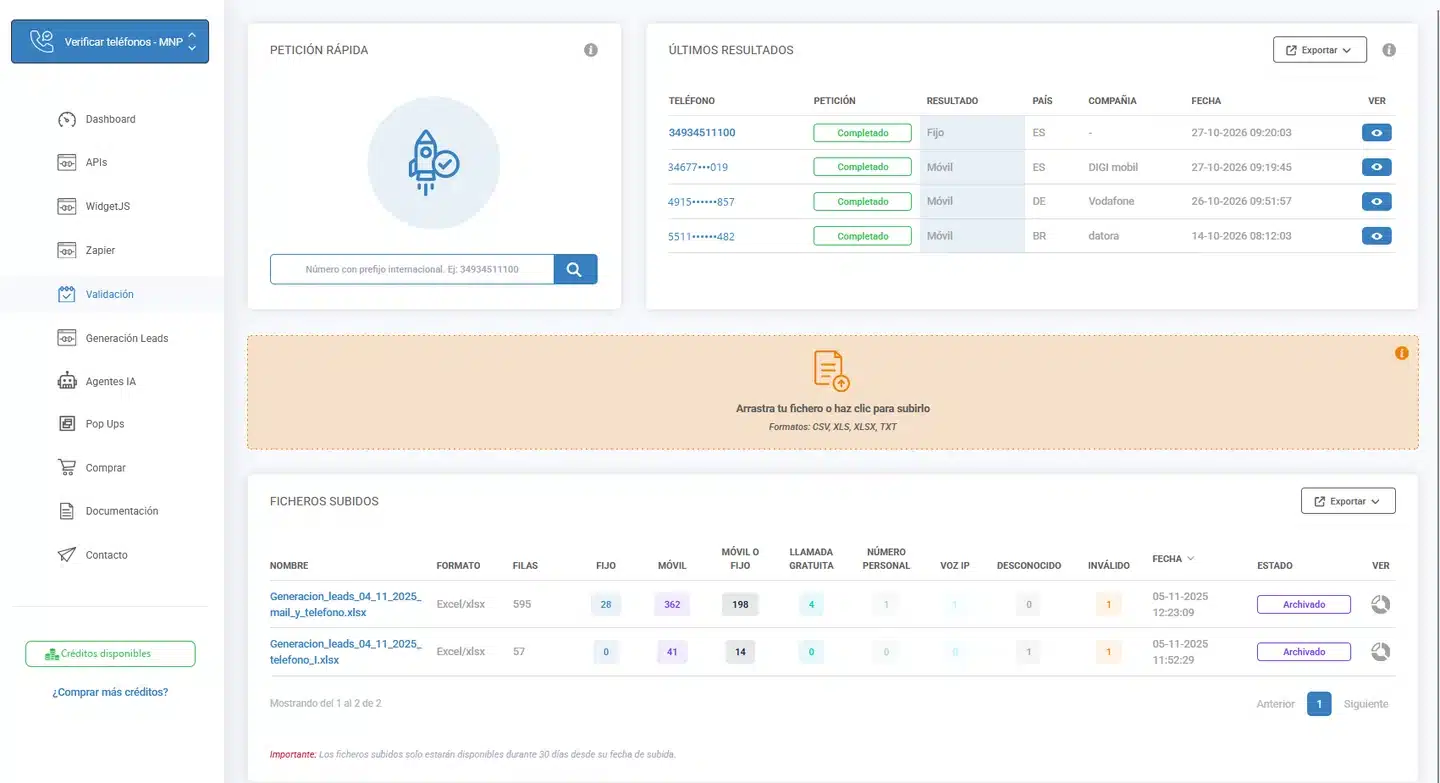
What it means. The portability lookup (MNP) gave the current operator of both mobiles, including the ported one: DIGI mobil. For the Movistar mobile, HLR also confirmed that the line was connected. For the mobile ported to Digi, HLR returned “no coverage” and only gave the original network (Vodafone), even though the VerificarEmails per-country price list shows Digi as a network with status.
The landline and the non-existent number were rejected by both lookups, but they were charged. The type returned by MNP (landline or unknown) lets you set them aside before paying for an HLR, which costs more. That is why, in Spain, it is best to run MNP first and then HLR, and to treat a “no coverage” result as “unverifiable”, not “invalid”. Four numbers do not measure any service’s accuracy, but they do show how each lookup responds.
With Twilio, the key case would be the ported mobile: it only documents portability in Canada, so we don’t know whether Line Type Intelligence would return Digi or Vodafone. Nor does it publish whether Line Status covers Spanish networks. We will only know once we test it.
File verification
In VerificarEmails we uploaded the four numbers in a file via MCP. The HLR lookup took 2 seconds and deducted 4.40 credits (1.10 per number); the portability lookup, another 2 seconds and 4 credits. The results matched the individual lookups. When we uploaded several files in a row, the service returned a 429 error (rate limit).
Twilio does not document file uploads in its console, and its batch API (Lookup Bulk) has been in private beta since October 2025, with access through sales. VerificarEmails deletes files after 30 days; Twilio says Lookup does not store data beyond its internal logs and sets a 30-day retention period for the number looked up.
What each lookup checks
A phone lookup can answer three different questions, and each one has its own price: whether the number is possible, which operator it belongs to and whether the line is active.
| What you want to know | Twilio Lookup | VerificarEmails |
|---|---|---|
| Whether the format and range are valid | Basic validation, free: valid and validation_errors | Syntactic lookup, based on the numbering plan (paid) |
| Whether it is mobile, landline, VoIP… | Line Type Intelligence: 12 types | In the syntactic, MNP and HLR lookups: 12 types |
| Which operator it has now | Line Type Intelligence: carrier_name and MCC/MNC; portability documented only in Canada | MNP: current operator, is_ported and MCC/MNC |
| What its original operator was | Not documented | original_network (HLR and syntactic) |
| Whether the line is active | Line Status (public beta): 5 statuses | HLR: connected, absent, no-teleservice-provisioned, inconclusive |
| Whether the SIM has changed recently | SIM Swap (private beta, with approval) | Not available |
Format and numbering plan
At VerificarEmails, MNP and HLR already return the number in the E.164 international format, so you don’t need a separate lookup to normalize it. If you only want format validation, the syntactic lookup costs €5 per 1,000 numbers.
Twilio’s basic validation is free for numbers from any country. It returns the number in E.164 and national format, and the valid field, with the reason for the error in validation_errors. Note: valid: true only means the number is in an assignable range; Twilio makes clear that it is not necessarily in service. And if you send a national number without specifying the country, it assumes it is a US number.
Line type and operator: MNP vs Line Type Intelligence
The VerificarEmails MNP lookup queries a portability database and returns the current operator, the is_ported flag and the MCC and MNC codes. In the test, it returned DIGI mobil (214-22) as the current operator of the mobile ported from Vodafone. If you want to route SMS or find out which operator a Spanish number has moved to, this is what you need.
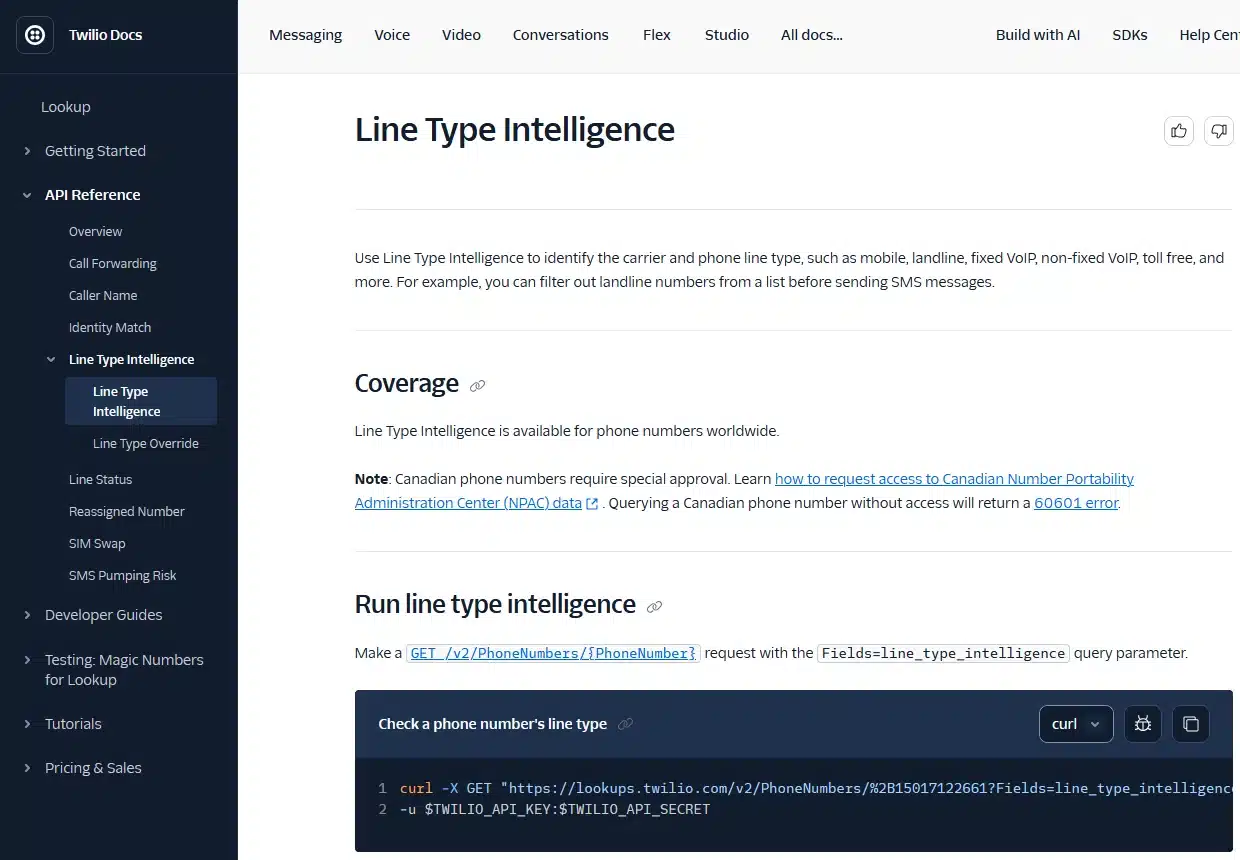
Line Type Intelligence returns one of twelve line types (mobile, landline, fixedVoip, tollFree…), the operator name and the MCC and MNC codes. Twilio does not explain whether the type comes from the numbering plan or from a network query, or whether the operator is the current one after porting. It only documents this for Canada, where it uses the Canadian portability registry (NPAC) if your access is approved.
Line status: HLR vs Line Status
The VerificarEmails HLR queries the mobile network and returns, in the same response, the status, the original and current operator, the portability flag, the line type and, depending on the operator, the IMSI. Its per-country price list shows 171 countries with at least one network with status; in Spain, 24 of 32 networks, including Movistar, Vodafone, Orange, Yoigo and Digi. In Mexico, Colombia, Peru and the US there is no HLR: only MNP. It charges for all lookups, including those with no coverage. To understand its limits, read why HLR verification fails and how to tell if a phone is active.
Line Status tells you whether a mobile is active. It is in public beta, self-service and with no SLA, and Twilio’s support plans don’t cover beta products. According to its launch blog, it queries the HLR “where available”; the documentation only mentions the operator’s network. It returns the status and an error code, without the operator.
Twilio does not publish a list of countries for Line Status: its page says it supports numbers worldwide, and the API reference says “140+ countries”. Both warn that it may not return data for some networks, and Twilio asks you to test coverage for each country and network. Spain is not mentioned. Nor does it document whether it charges for Unknown.
| Situation | Twilio Line Status | VerificarEmails HLR |
|---|---|---|
| Active line and handset connected | Reachable (Active if the line is active, without confirming it is reachable) | connected |
| Active line, but handset switched off or out of coverage | Unreachable | absent |
| Unassigned or invalid number | Inactive | No dedicated status documented; in the test, inconclusive and rejected |
| Line without calls or SMS (for example, a data SIM) | Not documented | no-teleservice-provisioned |
| The network does not respond or there is no coverage | Unknown | inconclusive or no-coverage |
| Is the indeterminate result charged? | Not documented | Yes, 1.10 credits |
SIM swap: an anti-fraud signal in private beta
Twilio’s SIM Swap package uses operator data to tell you whether a mobile’s SIM has changed recently. It helps stop account takeovers before you send a code or approve a risky transaction. Spain is among its countries and is one of the four, along with the UK, Germany and the Netherlands, where it returns the date of the last change. But it is in private beta: you have to wait for operator approval (2 to 4 weeks, according to Twilio) and the price is not public. VerificarEmails does not have an equivalent service.
Terms of use: the “for marketing purposes” clause
Before using Twilio Lookup to clean a marketing list, read its Identity Verification Requirements (last updated: 3 March 2025). According to their title, they apply to “Twilio Lookup API – SIM Swap and Line Type Intelligence, Lookup Call Forwarding, Reassigned Number, Identity Match” and to other Twilio verification services. Section 3 says:
“Customer will not use the Identity Verification Services or Identity Verification Data (a) for marketing purposes or to sell products or services”.
Section 2 also limits use to validating a consumer’s identity to prevent fraudulent transactions, verifying their identity or authenticating transactions, unless the order expressly allows other uses. It is unclear whether filtering landlines out of a list before an SMS campaign counts as use “for marketing purposes”. Twilio’s own pricing page presents Line Type Intelligence as a way to “scrub contact lists”. Line Status does not appear in the title of those terms, and its launch blog suggests it for list hygiene. If you are going to use Lookup with marketing lists, ask Twilio to confirm it in writing.
Pricing at equivalent volumes
At VerificarEmails you pay in euros, with no subscription, with prepaid packs valid for one year, and the same credits work for single lookups and files. Its HLR uses 1.10 credits per lookup, so 1,000 lookups need 1,100 credits. Twilio charges in dollars per request and per package: if you request two packages at once, you pay for both. Its Lookup pricing page was last updated in October 2026. We compare lookup by lookup, with the same scope.
| Lookups | VerificarEmails MNP | Twilio Line Type Intelligence |
|---|---|---|
| 1,000 | €10 | $8 ≈ €7.13 |
| 10,000 | €80 | $80 ≈ €71.34 |
| 50,000 | €240 | $400 ≈ €356.70 |
| 100,000 | €440 | $800 ≈ €713.39 |
At 50,000 and 100,000 lookups, VerificarEmails MNP costs €240 and €440, vs about €357 and €713 for Line Type Intelligence. MNP also documents portability, while Twilio only does so for Canada. Up to 10,000 lookups, Line Type Intelligence costs less (about €7 and €71, vs €10 and €80), paid in dollars.
| Lookups | VerificarEmails HLR | Twilio Line Status | Twilio Line Status + Line Type Intelligence |
|---|---|---|---|
| 1,000 | €20 | $7 ≈ €6.24 | $15 ≈ €13.38 |
| 10,000 | €90 | $70 ≈ €62.42 | $150 ≈ €133.76 |
| 50,000 | €430 | $350 ≈ €312.11 | $750 ≈ €668.81 |
| 100,000 | €860 | $700 ≈ €624.22 | $1,500 ≈ €1,337.61 |
The VerificarEmails HLR publishes its coverage in Spain (24 of 32 networks) and returns the status, the line type and the operator in the same response. To get that data from Twilio you have to add Line Type Intelligence to Line Status, and then VerificarEmails is cheaper from 10,000 lookups: €90 vs about €134, and €860 vs about €1,338 at 100,000. On its own, Line Status costs less per lookup than HLR: $0.007, about €624 at 100,000 vs €860. It is paid in dollars, it is in public beta and Twilio does not publish its coverage in Spain. If the network does not respond, as happened in the test with the mobile ported to Digi, MNP gives you the current operator.
- Currency and expiry: VerificarEmails charges in euros and its packs are valid for one year, renewed if you top up the same service within that year. Twilio does not publish whether the balance expires.
- Files: at VerificarEmails, a file is charged the same as single lookups, per record. At Twilio, the batch API is in private beta and you request it from sales.
- Tax and payment: Twilio charges in dollars, excluding tax: it applies VAT to individuals, but not to businesses with a valid VAT number (reverse charge). It works with a prepaid balance and optional auto-recharge; paying by invoice requires a committed spend of at least $12,000 a year.
- Free: VerificarEmails gives you test credits when you create your account. The Lookup trial account starts with 100 free units and expires after 30 days.
- Indeterminate results: VerificarEmails charges for every record whatever the result, including rejected ones and those with no coverage. Twilio does not document whether it charges for a Line Status
Unknownor a Line Type Intelligenceunknowntype. - Format: VerificarEmails MNP and HLR already return the number in E.164; its syntactic lookup costs €5, €40, €120 and €220 for 1,000, 10,000, 50,000 and 100,000 numbers. Twilio’s basic validation is free.
- Tiers: Line Status drops to $0.0063 from 100,001 lookups, and further in the following tiers; Twilio does not clarify whether they are counted per month or whether they are graduated. Line Type Intelligence has a single price.
- Outside Spain: the VerificarEmails per-country price list shows a higher HLR rate for most countries (0.02 vs 0.01 in Spain). We have not tested it.
You’ll find all the packs on the phone verification pricing page.
API, integrations and MCP
API. Both offer real-time lookups via REST API.
- VerificarEmails has an endpoint for each lookup (
/phone/validate/singlefor HLR and/phonemnp/validate/singlefor MNP) and a file API. Its API keys support a total and a per-minute limit set from the dashboard, and its documentation includes examples in PHP, Python, Ruby, C# and Node. You’ll find everything on the phone validation API page. - Twilio uses a single request,
GET /v2/PhoneNumbers/{number}, to which you add the packages inFields. It looks up one number per request. It has official SDKs for Node.js, Python, C#, Java, Go, PHP and Ruby, plus its CLI. By default it processes data in the US (US1), but you can choose Ireland (IE1); it warns that data may leave the region when it queries external providers.
Console. In the VerificarEmails dashboard you can upload a file of numbers without coding. To try Lookup without coding, Twilio documents its console at 1console.twilio.com (Identity > Lookup > Overview > “Try out Lookup”). There you choose the packages and look up one number at a time.
A platform for developers. The Twilio console groups dozens of communications and identity products, and Lookup is just one of them. Its documentation presents each lookup as a GET request to the API with the key and secret, and with the Fields parameter to request the line type or the status. A marketing or sales team that just wants to validate a list will have to code it or rely on its developers. At VerificarEmails you upload the file from the dashboard and download the result.
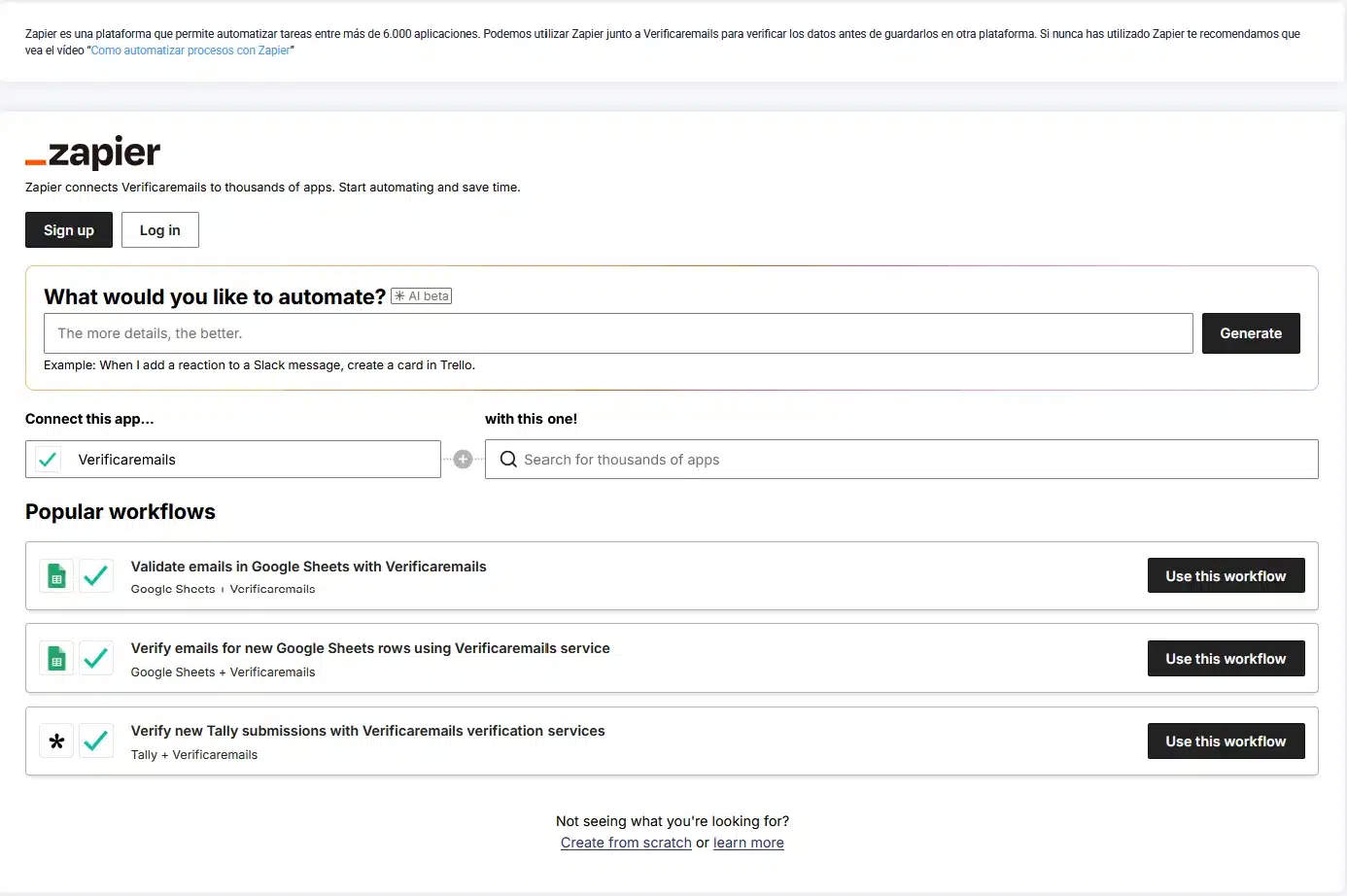
Integrations. VerificarEmails connects with Zapier, n8n (its own node) and Excel, and its pop-ups can verify the phone number in each field with the syntactic lookup, HLR or portability. The Twilio app on Zapier has no Lookup action, and Twilio does not document form plugins for Lookup.
MCP (AI assistants). Both have an official MCP server, but they do different things:
- VerificarEmails offers a remote server that you connect to with your account (OAuth), with nothing to install. It exposes 14 tools, including HLR (
validate_phone), portability (validate_phone_mnp), file upload, file status, download and balance. - Twilio has an official MCP server in public beta, with no authentication and two tools: searching the documentation and retrieving the API schemas. It does not run API calls; Twilio announces executable tools with OAuth as planned. Separately, Twilio publishes on GitHub (twilio-labs) a proof of concept that does run Lookup queries, is installed on your machine and receives the credentials as an argument. It has no tools to upload files or download results.
In the test we used the VerificarEmails MCP for the individual lookups and the files. We did not test Twilio’s MCP servers.
Multi-data verification and the NewsletterSoft workflow
A sign-up form rarely asks only for a phone number. With the same VerificarEmails account you can run multi-data verification:
- the phone number, with an HLR lookup to find out whether the mobile is active or a portability lookup to find its current operator (verify phone numbers);
- the email;
- the first and last name;
- the postal address.
Each service has its own credits. Twilio Lookup only handles phone numbers; in this comparison we have not reviewed other Twilio products.
This is the phone workflow in NewsletterSoft (in Spanish): the number is captured, normalized and verified according to the country, and then you decide whether the contact goes into the segment for an SMS campaign. For each step we indicate whether it is a native feature or requires the API, MCP or manual work:
| Step | What happens | How |
|---|---|---|
| 1. Capture | A NewsletterSoft pop-up or landing page collects the number in a phone field. | Native |
| 2. Normalize | The number is converted to E.164 with the form’s format validation or with the format.e164 field returned by MNP and HLR. | Native (field format) · API or MCP (format.e164) |
| 3. Verify by country | In Spain, MNP first (current operator) and then HLR (status). A “no coverage” or rejected number is “unverifiable”, not “invalid”. In Mexico, Colombia, Peru and the US, MNP only. | API /phonemnp/validate/single and /phone/validate/single · MCP validate_phone_mnp and validate_phone |
| 4. Store the result | The status and the operator are saved in a contact attribute or tag. | NewsletterSoft API or MCP (update the contact). Manual: import a CSV with a status column. |
| 5. Segment | A segment groups the contacts with that attribute and contactable = sms. | Native (segment editor) · API · MCP |
| 6. Send | The SMS campaign is sent to that segment. | Native |
With Twilio Lookup, step 3 would be done with its API (Line Type Intelligence and Line Status), because its official MCP does not run lookups. Before that, check the marketing clause in its terms, which we explained above.
Strengths of each
VerificarEmails
- It documents portability: its MNP gives the current operator and whether the number is ported. In the test it returned DIGI mobil for the mobile ported from Vodafone.
- It publishes which networks return line status: 24 of 32 in Spain, including Movistar, Vodafone, Orange, Yoigo and Digi.
- It combines the two lookups you need in Spain: MNP for the current operator and HLR for the line status. Both return the number in E.164.
- It offers self-service bulk lookups: CSV, XLS, XLSX or TXT files in the dashboard, via API and via MCP.
- It charges in euros, with no subscription, with packs valid for one year. Its MNP costs less than Line Type Intelligence at 50,000 and 100,000 lookups.
- Its API documentation includes examples in PHP, Python, Ruby, C# and Node, and you can set a total and a per-minute limit on each API key from the dashboard.
- It is a Spanish company with servers in the EU and a published data processing agreement.
- Its MCP is remote, with OAuth and nothing to install, and runs HLR, MNP and files.
- With the same account it also verifies email, name and address, and its pop-ups verify the phone number in the form itself.
Twilio Lookup
- Format validation is free, for numbers from any country.
- Line Status costs less per lookup than the VerificarEmails HLR, and Line Type Intelligence costs less than MNP up to 10,000 lookups. Both are paid in dollars, and Line Status is in beta.
- It offers fraud and identity signals: SIM Swap and Identity Match (both in Spain, with operator approval) and SMS Pumping Risk.
- It has official SDKs for seven languages and lets you process lookups in Ireland.
- Twilio publishes certifications such as ISO 27001 and SOC 2, although it does not say whether Lookup is within their scope.
Our recommendation
Choose VerificarEmails if:
- you want to validate phone lists without coding or relying on developers: from the dashboard, with files;
- you work with Spanish numbers and need the current operator after porting (MNP) and the line status (HLR) on networks with published coverage;
- you clean lists for SMS campaigns by uploading a file, with no coding and without going through sales;
- you want to pay in euros, with no subscription, with packs valid for one year;
- you need servers in the EU and a published data processing agreement;
- you also want to verify emails, names and addresses with the same account, or in your pop-ups;
- you work with an AI assistant and want a remote MCP that runs lookups and files with nothing to install.
Twilio Lookup may be a fit if you already use Twilio, look up numbers one by one from your application or need to detect SIM swaps before sending a code.
Frequently asked questions
Is Twilio Lookup free?
Only partly. Basic validation is free: it checks the format, returns the number in E.164 and tells you whether it is in an assignable range, but not whether it is in service. The packages that tell you more about the number are paid, in dollars: Line Type Intelligence costs $0.008 per lookup and Line Status, in public beta, $0.007. The Lookup trial account starts with 100 free units and expires after 30 days. VerificarEmails gives you test credits when you create your account.
How much does Twilio Lookup cost in Spain?
Twilio publishes its prices in dollars, excluding tax. At 10,000 lookups, Line Status costs $70 ≈ €62.42 and Line Type Intelligence, $80 ≈ €71.34; Line Status is in public beta and Twilio does not publish its coverage in Spain. At VerificarEmails you pay in euros, with no subscription: at 10,000 lookups, HLR costs €90 and MNP €80; at 100,000, MNP costs €440, vs $800 ≈ €713.39 for Line Type Intelligence. Twilio does not charge VAT to businesses with a valid VAT number (reverse charge), but it does charge it to individuals. SIM Swap has no public price: you contract it through sales.
Does Twilio Lookup do HLR lookups?
Its equivalent is Line Status, which is in public beta and has no SLA. It returns five statuses: Active, Reachable, Unreachable, Inactive and Unknown. According to its launch blog, it queries the HLR “where available”; the documentation only says it queries the operator’s network. It does not return the operator, and Spain is not mentioned in its coverage. The VerificarEmails HLR publishes its coverage in Spain (24 of 32 networks) and returns the status together with the operator and the line type.
Does Line Type Intelligence detect porting?
Twilio does not document it. Line Type Intelligence returns the line type, the operator name and the MCC and MNC codes, but does not explain whether that operator is the current one after porting. The exception is Canada, where it uses the Canadian portability registry if your access is approved. To find the current operator of a Spanish number, use an MNP lookup: in our test, the VerificarEmails one returned DIGI mobil for a mobile ported from Vodafone.
How is Twilio Lookup different from Twilio Verify?
Lookup retrieves data about a number without sending it anything: format, line type, operator, line status or SIM change. Verify is Twilio’s product for sending and checking one-time passcodes (OTP) when registering or authenticating a user. They can be combined: for example, checking SIM Swap before sending a code. We explain it in our article on SIM swap.
Does Twilio Lookup detect SIM swaps in Spain?
Yes. Spain is one of the SIM Swap countries, and one of the four where it returns the date of the last SIM change. But it is in private beta: you have to register your use case and wait for operator approval, which Twilio estimates at 2 to 4 weeks. The price is negotiated with sales.
Can I verify a list of numbers with Twilio Lookup?
Not as self-service. The standard API looks up one number per request, and the trial console one at a time. Twilio has a batch API (Lookup Bulk) in private beta, with access through sales. Also, its terms for Line Type Intelligence prohibit use “for marketing purposes”, so it is best to ask Twilio before cleaning a marketing list. At VerificarEmails you can upload a CSV, XLS, XLSX or TXT file in the dashboard, via API or via MCP, without going through sales.
Methodology, review date and sources
- Date: data and tests from 11 November 2026.
- Sample: four Spanish numbers (a mobile ported from Vodafone to Digi, a Movistar mobile, a number from an unassigned range and a Barcelona landline). In VerificarEmails, HLR and MNP lookups via MCP and with a file. We have not tested Twilio Lookup: what we say about it comes from its documentation.
- Prices: each provider’s public pages on that day, excluding tax. For dollars we used the ECB reference rate of 10 November 2026. The VerificarEmails HLR is calculated at 1.10 credits per lookup with the cheapest combination of packs.
- Limits: four numbers do not measure any service’s accuracy, only how each lookup responds. The sample does not include Orange or Yoigo lines, Vodafone as the current operator or a switched-off line. We have not tested numbers from outside Spain or Twilio’s MCP servers.
Twilio Lookup sources: pricing, Lookup v2 reference, Line Status, Line Status launch blog, Line Type Intelligence, Lookup getting started guide, SIM Swap, SIM Swap countries, one number per request, Lookup Bulk, trying Lookup in the console, regions, MCP, Twilio Labs MCP, Identity Verification Requirements, VAT, billing, support plans and data protection addendum.
VerificarEmails sources: phone pricing, phone documentation, data processing agreement and MCP.
Looking for other options? See our comparison of the best phone number verification APIs. We also compare VerificarEmails with Numverify and HLRLookup.com.