


















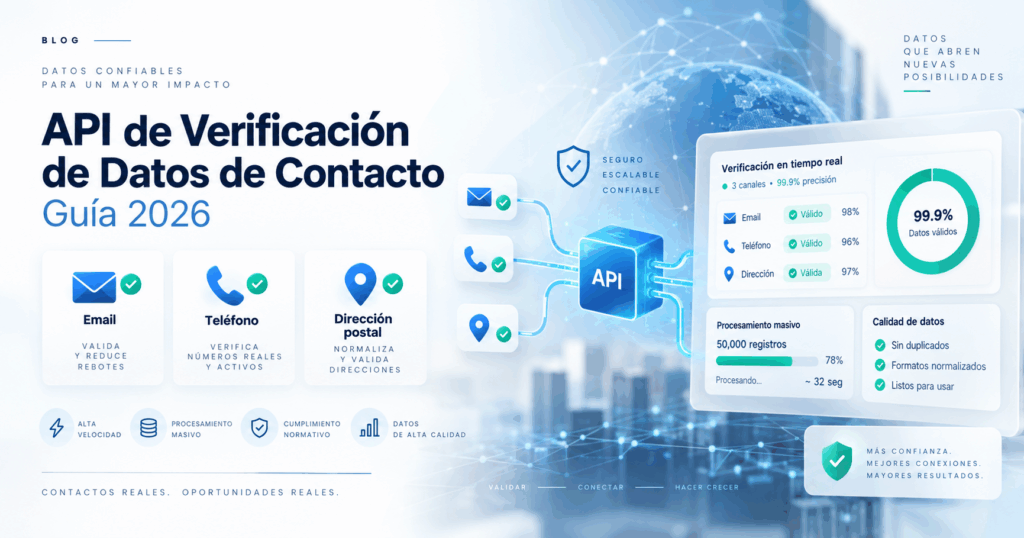
How to validate a phone number Choosing the right contact data verification API in 2026 requires evaluating the depth of accuracy, processing speed, compliance standards, and total cost, all based on your specific business needs.
- Verify at the point of capture: Real-time validation during user interaction prevents invalid data from entering your database before it contaminates any subsequent workflows.
- Email lists deteriorate 22-30% per year: Implement automated quarterly bulk checks along with real-time checks to combat natural data deterioration.
- Response time directly affects user experience: The best APIs offer verification speeds of 300-500ms, which are essential for validating forms without the user abandoning the sign-up process.
- Verification with associated identity reduces failed scope: Confirming contact ownership prevents misdirected communications. A single incorrect sales call can cost more than 17 verifications with associated identity.
- Poor data quality costs $12.9 million per year: Combining multichannel validation, automated CRM maintenance, and GDPR compliance turns data quality into a real competitive advantage.
What is a Contact Data Verification API and How It Works
“You can have all the fancy tools you want, but if the quality of your data isn’t good, you’re not going to get anywhere.” — Veda Bawo, Director of Data Governance, Raymond James
Definition and Key Functions
A contact data verification API is a programmatic service that confirms the accuracy and deliverability of email addresses, phone numbers, and physical addresses before they enter your systems. It works as a set of protocols that allows applications to send verification requests and receive structured responses with validation status, risk alerts, and enrichment data.
The main goal is clear: to prevent invalid data from contaminating your database. When integrated into forms, CRMs, or workflows, the API checks contact information against authoritative sources and returns results that tell you whether to accept, reject, or flag each entry. This validation happens at the time the data is captured or through bulk processing of existing lists.
What’s the Difference Between Real-Time Verification and Bulk Verification?
Real-time verification runs during user interaction, completing the process in 300-800 milliseconds per address. Your application sends a contact to the API endpoint, receives the response immediately, and decides whether to proceed with the form submission. This synchronous approach blocks invalid entries before they are stored in the database.
Bulk verification, on the other hand, processes entire lists asynchronously. You upload a CSV file with thousands or millions of records and the service returns the results in minutes or hours depending on the volume. Real-time verification prevents contamination at the point of entry, but mailing lists deteriorate by approximately 22-30% annually, so quarterly bulk reviews are necessary even when you already have real-time protection.
API Architecture and Integration Points
Contact data verification APIs primarily use REST architecture with HTTP methods (GET, POST) to handle requests. The interaction layer handles incoming validation requests, processes authentication, and communicates responses in JSON or XML format. Integration can be done through direct API calls from web forms, middleware connections with CRMs, or SDK implementations for mobile apps.
The application layer executes the verification logic based on the requests received, while the integration layer coordinates the flow of data between your systems and the verification service. Most vendors offer webhook support for asynchronous completion of bulk jobs, thus avoiding the need for constant queries.
How Email
Verification Is Performed The email verification process performs four sequential technical checks without sending any actual messages:
- Syntactic Validation: Confirms compliance with the RFC 5322 format, detecting missing @ symbols, invalid characters, and structural errors in milliseconds.
- Domain Validation: Performs DNS queries to verify that the domain exists and resolves correctly.
- MX Record Check: Confirms that mail exchange records exist and identifies which servers handle the domain’s mail.
- SMTP Probe: Opens a connection to the recipient’s mail server and uses RCPT TO commands to verify that the specific mailbox exists, without transmitting any data.
The process takes between 300 and 800 milliseconds per address, with DNS-only failures completing in 100-200 ms at best. In addition, disposable addresses, role-based accounts (info@, support@), and catch-all domains that accept mail for any recipient are detected.
Phone Number Validation
Phone validation confirms that numbers follow international numbering plans and then queries carrier databases to verify active status. The API returns numbers formatted in the E.164 standard, identifies the carrier, determines the line type (mobile, landline, VoIP), and provides geo-location data, including country, city, and time zone. This validation covers between 232 and 237 countries and helps ensure compliance with contact regulations.
Multichannel Data
Validation Modern verification APIs validate email, phone, and postal address data across unified endpoints. This allows you to verify complete contact records in a single API call, standardizing postal addresses according to country-specific formats and simultaneously checking mail deliverability and phone connectivity.
Remember that this unified integration reduces technical complexity and ensures consistent data quality across all customer touchpoints.
Key Features to Look for in a Data
Verification API Not all contact data verification APIs deliver the same results. Before choosing one, you should evaluate specific technical and operational capabilities that directly affect the quality of your data and how easily the integration fits into your existing systems. These are the features that really matter.
Accuracy and Depth of Verification Methods
The accuracy of verification depends entirely on how many checks the API performs during validation. Superficial syntactic checks only detect obvious formatting errors; they will not detect addresses that cannot be delivered mail or disconnected phone numbers.
Robust APIs perform multi-layered validation: SMTP probes for email addresses, carrier queries for phone numbers, and checks with postal authorities for physical addresses. When evaluating a provider, ask them to document which verification methods they use and provide accuracy metrics for different types of validation. Remember that false positive rate is just as important as detection ability: blocking legitimate contacts directly hurts your conversion rates.
Multi-Channel Support (Email, Phone, and Address)
Unified APIs that validate email, phone, and physical address data using consistent endpoints greatly reduce integration complexity. Instead of managing separate services for each type of data, multi-channel verification allows complete contact records to be sent in a single API call.
This approach standardizes cross-channel validation logic while supporting country-specific formatting requirements for addresses and international phone numbering plans that cover between 232 and 237 countries. If you’re working with international audiences, this is a feature you can’t overlook.
Real-Time
Processing Speed API response time determines whether you can validate contacts during form submission without compromising the user experience. Industry expectations put real-time API latency at 30 ms or less, staying up to the 99th percentile of requests. While simple operations can be completed in less than 100 ms, sustained performance under load matters far more than speed achieved under best conditions.
We recommend that you request the p95 and p99 latency metrics for the various types of verification before committing to a provider. SMTP probes for email inherently take longer than phone number format checks, so understanding this difference helps set realistic expectations.
Data
Security and Compliance Standards
Verifying contact data involves processing personal information, which means compliance with GDPR, HIPAA, and industry standards is non-negotiable. APIs that handle healthcare data require HIPAA certification. Financial services require PCI DSS compliance and SOC 2 Type 2 certification.
Check that suppliers keep their compliance certifications up to date, encrypt data both in transit and at rest, and provide audit trails for regulatory reporting. GDPR compliance specifically requires data minimization, purpose limitation, and full compatibility with data subject rights. If a provider cannot clearly demonstrate these practices, look for another alternative.
API Documentation and Ease of Integration
Poor documentation is one of the most undervalued costs when choosing a verification API. Comprehensive API documentation should include OpenAPI specifications, authentication examples, error code references, and SDK support for the most common languages.
Well-documented APIs reduce developer frustration and speed up implementation. Poor documentation, on the other hand, leads to support team dependencies that slow down development cycles and increase costs. A practical tip: test the documentation during the evaluation by performing a sample integration before signing any contract. This will tell you more than any business conversation.
Pricing and Scalability
Model Contact data verification pricing typically follows one of four models: pay-per-call, tiered volume pricing, subscription packages, or credit-based systems. The per-call model charges a fixed amount for each verification request. Tiered models reduce the unit cost as volume increases. Volume-based subscriptions offer cost predictability through monthly fees. Credit systems abstract backend complexity into consumable units.
Before you commit, make sure you understand whether failed verification attempts incur charges and how the price evolves as your validation volume increases. Hidden costs often appear when providers charge separately for different types of verification or bill failed attempts at full price. Make sure you understand exactly what you’re paying for before you escalate.
Comparison: Top Contact Data Verification Solutions for 2026
The Evaluation Criteria That Really Matter
To compare contact data verification solutions, you need to go beyond marketing arguments and analyze actual operational performance metrics. The billable unit defines what you actually pay: some vendors charge per verification event, others per document processed, and some set the price per session or user rather than per individual check. The scope of the transaction also matters, as one vendor’s “verification” may include multiple checks while another bills each step separately.
Verification depth is what separates a basic format validator from a solution that makes SMTP connections, queries to telephony operators, and checks with postal authorities. SMTP-only validation achieves only 45% accuracy on enterprise B2B lists, while AI-assisted hybrid methods reach 94-98%. Handling catch-all domains presents a specific challenge: these configurations accept mail for any address, making standard SMTP checks inconclusive. This forces AI-assisted classification to be used for 20-40% of enterprise B2B lists.
And what about response times? Real-time verification for registration forms demands a latency of less than 500 ms, with leading vendors offering response times of 350-500 ms. When it comes to cleaning databases with millions of records, performance in bulk processing becomes critical—vendors like Emailable process up to 30,000 addresses per minute.
Vendor Comparison: Functionalities and Capabilities
Identity verification platforms show considerable variation in document support, biometric verification, and fraud detection. Document coverage ranges from more than 2,500 types (Entrust) to more than 16,000 types (Regula), including different categories of documents, regional variants, and older versions that are still in active circulation.
Biometric capabilities have evolved beyond simple facial recognition and now include liveness detection, age estimation, and familiar face search. The sophistication in detecting signs of fraud also differs markedly: some vendors analyze more than 1,000 session signals including behavioral patterns, while others focus primarily on device and IP data.
Pricing Models Between Suppliers
Pricing models in contact data verification reflect fundamental differences in how each supplier measures and bills for usage. Transactional models charge per verification event, with email verification generally costing between £0.00 and £0.02 per verification, and phone verification with identity ID around £0.07 per number. Pay-as-you-go packages are usually prepaid, and unused transactions may or may not accumulate between billing periods.
For enterprise-scale operations, 10,000 email verifications can cost between £7.94 and £63.53 depending on the provider and depth of functionalities. Credit-based systems simplify backend complexity across consumption units, with some solutions charging 10 credits for full verification. Flat-rate licenses are suitable for scenarios with recurring user verification, especially in access control and employee authentication.
Identity ID Verification vs. Standard Validation
Standard validation confirms that contact information is syntactically correct and technically achievable. Identity ID verification goes a step further: it cross-checks validation with identity graphs to confirm that the contact belongs to a specific person.
This distinction matters when the cost of contacting the wrong person exceeds the cost of verification. A single misdirected sales call with a total cost of £1.11 warrants 17 verifications with identity identification at £0.07 each.
Remember that APIs with identity ID return confidence scores (0-100) along with verdict fields that condense the analysis of complex signals into actionable results: verified, probable, unconfirmed, discrepancy, or invalid. Standard validators return only the deliverability status without confirming the identity of the recipient.
How to Choose the Right Data Validation API for Your Business
Not all APIs are designed the same way. Before hiring any service, stop for a moment and evaluate what your business really needs. This way you can make the decision with greater confidence.
What Verification Scenarios Is Your Business Facing?
Start by relating your verification requirements to specific business scenarios. Response times of less than 500ms are a must for real-time form validation: slow responses cause users to abandon the process during registration. On the other hand, if you’re cleaning up an existing database using bulk processing, total throughput matters much more than the speed of each individual request.
Remember that a call center that needs to validate phones associated with an identity has very different requirements than an e-commerce focused on email deliverability. Clearly define your use case before evaluating any provider. Also consider whether you need catch-all domain classification. These configurations accept mail for any address and affect 20-40% of enterprise B2B lists; standard SMTP probes alone are not enough. You’ll need AI-assisted methods to manage them properly.
Does the API Fit with Your Current Tech Stack?
The complexity of integration increases quickly when an API doesn’t fit with your infrastructure. Most contact verification services use REST APIs, but you’ll need to confirm SDK or client library support for your specific programming language.
Be wary of APIs designed primarily for bulk processing, as they may lack support for webhooks that notify you of asynchronous job completion, forcing your team to use inefficient periodic query systems. Also check that the available authentication methods (OAuth 2.0, API keys, JWT tokens) are compatible with your security requirements and your current identity management systems. An incompatibility at this point can add weeks to the integration timeframe.
What is the True Total Cost of Ownership?
The price per verification is just the starting point. Upfront costs include the work required to integrate the API, which can take anywhere from a few days with a well-documented service to several weeks with a poorly supported platform. Operational costs accrue through monthly subscription fees, overage charges, and separate billing for different types of verification.
Also consider maintenance costs. APIs that require custom code to manage usage limits, error conditions, or schema changes generate ongoing technical debt. Calculate the total hourly cost of the technical staff in charge of managing the integration, including profits, taxes, and indirect costs, before making any final cost comparisons.
Test Before You
Commit Performance testing lets you know if an API supports actual production loads. Load testing simulates the expected number of concurrent users to identify bottlenecks, while stress testing exceeds the normal ability to locate breakpoints.
Always request p95 and p99 latency metrics for different types of verification. Averages hide the worst experiences, which are precisely the ones that frustrate users the most. Accuracy testing is just as important: it processes sample data using the API and measures false positive rates along with detection capability. Blocking legitimate contacts hurts conversion rates, so this step isn’t optional.
Review Documentation and Support Before Signing
The quality of documentation is a good indicator of integration speed and long-term maintenance burden. A comprehensive API documentation should include OpenAPI specifications, authentication examples, error code references, and troubleshooting guides.
We recommend performing a proof-of-concept integration before signing any contract—this is the fastest way to check if the documentation is actually usable. Also, check the responsiveness of support using developer forums, issue activity on GitHub, and stated SLA commitments for technical queries. If support is slow during the evaluation, it will probably be even slower once you’ve signed.
Best Practices for Implementing Contact Data Verification
“Poor data quality costs organizations an average of $12.9 million per year, according to Gartner.” — Gartner, Research and Consulting
Firm Data quality issues rarely appear all at once. They accumulate quietly, record by record, until your campaigns stop hitting their goals, your sales team chases dead-end opportunities, and your compliance team starts asking uncomfortable questions. The good news? A few well-implemented practices stop the problem before it grows.
Validate at the Data
Capture Point The best time to detect an incorrect contact record is right when it arrives. The accuracy of the verification is higher when the validation is performed during the user interaction, rather than being used later as a cleanup process. Real-time checks stop invalid entries before storing them in the database, preventing all subsequent processes from inheriting corrupted data.
Set up validation rules on input interfaces using restricted fields and immediate field-level messages. Think of it as installing a filter on the faucet instead of trying to clean contaminated water once it’s already gone through all the pipes.
Set up Automated CRM
Maintenance Contact data deteriorates by 22.5% to 70% per year, so scheduled maintenance is a must. Even if you check all contacts at the time of capture, existing records get older every day.
Establish a maintenance schedule that works over three time horizons:
- Weekly: Validation analysis of active records that are currently being used by sales or marketing teams.
- Monthly: Enrichment processes for incomplete data with missing fields.
- Quarterly: Deep cleaning that includes full database deduplication.
Automation eliminates manual remediation cycles that reduce productivity while improving data consistency. Your team shouldn’t spend time on tasks that a scheduled process can perform automatically.
Combine Multiple Verification Methods
No single verification method detects all problems. Combining different approaches allows you to optimize both security and the user experience for different needs. For example, SMS verification works well as the default option on iOS, while Flash Call on Android reduces costs without hurting success rates. When none of these options are suitable, data verification provides the fastest method without requiring any user interaction.
Remember that the goal is not to add friction, but to confirm the accuracy of the data as smoothly as possible for each specific scenario.
Monitor Verification Results and Adjust Thresholds
Setting up verification is only half the job. Define warning and critical thresholds for your validation metrics, and then continuously track them against the collected baselines over several weeks. Set calculation intervals to distinguish transient issues from persistent ones that actually require intervention.
Thresholds defined on day one rarely remain accurate over time. Adjust them based on patterns observed in your own data rather than relying on arbitrary defaults. What works for an e-commerce database with millions of records can be very different from what a B2B contact list of a few thousand needs.
Ensure GDPR Compliance and Privacy
Verification affects personal data, so compliance cannot be a secondary consideration. Implement data protection by design through encrypted consent storage, role-based API access, and automated compliance checks. Keep audit trails of all verification operations so you can prove lawful handling of data when necessary.
Set up consent management to immediately process any revocation, automatically excluding the affected data from processing. If a contact withdraws their consent, that opt-out should occur without the need for any manual steps. All communications should be encrypted and contact details should be stored in accordance with applicable privacy obligations.
If you need help integrating verification into your existing CRM or ERP systems in a compliant way, our support team is available to help you through the process.
Conclusion
Contact data verification APIs have become essential tools for maintaining database quality and avoiding the costly accumulation of invalid contacts. As such, your choice should balance depth of accuracy, real-time performance, multi-channel compatibility, and total cost of ownership with your specific business needs.
At VerifyEmails, we’ve seen organizations transform their data quality by implementing verification at capture points, combining different validation methods, and maintaining automated cleansing programs. Spend time testing API performance with your real-world use cases, assessing the quality of documentation, and calculating all costs before committing. Your verification strategy directly determines your ability to contact your customers, your level of regulatory compliance, and ultimately, the revenue earned through each channel.
Frequently Asked Questions
Q1. What is the difference between real-time contact verification and bulk verification? Real-time verification validates contact information immediately during user interaction, typically within 300-800 milliseconds per address. This synchronous method blocks invalid entries before they reach your database. Bulk verification, on the other hand, processes entire lists asynchronously: you upload a file with thousands or millions of records, and the results are returned after minutes or hours, depending on the volume. While real-time verification prevents contamination at the point of entry, bulk verification helps combat the deterioration of data that already exists in your database.
Q2. How accurate are the email verification APIs? The accuracy of email verification varies considerably depending on the depth of the checks performed. SMTP-only validation achieves approximately 45% accuracy on enterprise B2B lists, while AI-assisted hybrid methods can achieve between 94% and 98%. The most efficient verification processes perform multiple sequential checks, such as syntactic validation, domain validation, MX record query, and SMTP probes. In addition, advanced systems can manage catch-all domains—which accept mail for any address—using AI-assisted classification, solving a problem that affects 20-40% of enterprise B2B lists.
Q3. How much should I expect to pay for contact data verification services? Prices vary considerably depending on the provider and the type of verification. Email verification typically costs between £0.00 and £0.02 per verification, while phone verification associated with an identity costs around £0.07 per number. For enterprise-scale operations, 10,000 email verifications can cost between £7.94 and £63.53 depending on the provider and the depth of capabilities. Most providers offer pay-per-verification transactional models, tiered pricing based on volume, subscription packages with monthly fees, or credit-based systems. It’s important to know if failed verification attempts result in charges and how the price evolves as volume increases.
Q4. How quickly do the Contact Verification APIs process requests? Response time depends on the type of verification and use case. For real-time verification during form submission, industry expectations put API latency at 30 ms or less to provide an optimal user experience, although email verification using SMTP probes is typically completed in 350-500 milliseconds. In bulk processing, the volume processed becomes more important than the speed of each individual request: major vendors can process up to 30,000 addresses per minute. When evaluating vendors, ask for p95 and p99 latency metrics to understand performance in worst-case scenarios under load and not just average times.
Q5. Why does the quality of contact data deteriorate over time? Contact data naturally deteriorates at a rate of 22.5-70% per year due to a variety of factors. Email addresses become invalid when users change jobs, abandon accounts, or domains expire. Phone numbers disconnect when people change carriers or cancel their services. Physical addresses change when people move. This deterioration means that even using real-time verification at the point of capture, massive quarterly reviews are still necessary to maintain the Database quality. Poor data quality costs organizations an average of $12.9 million per year, making ongoing maintenance a necessity rather than an option.